How to Start Learning Agentforce

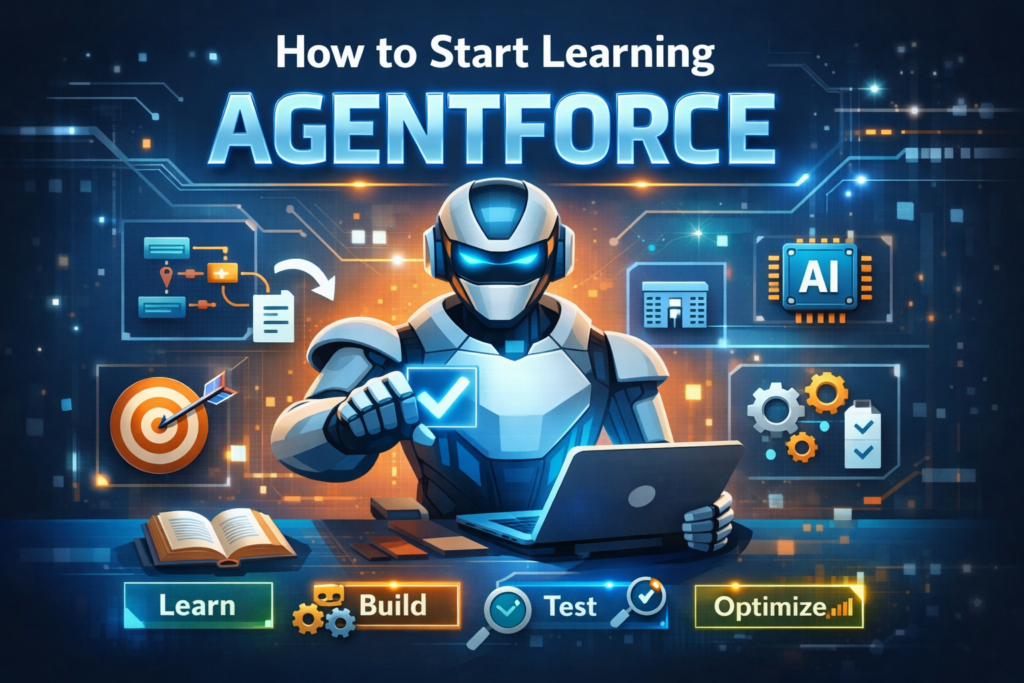
A practical, story-driven guide for beginners who want to become effective with Agentforce
Table of Contents
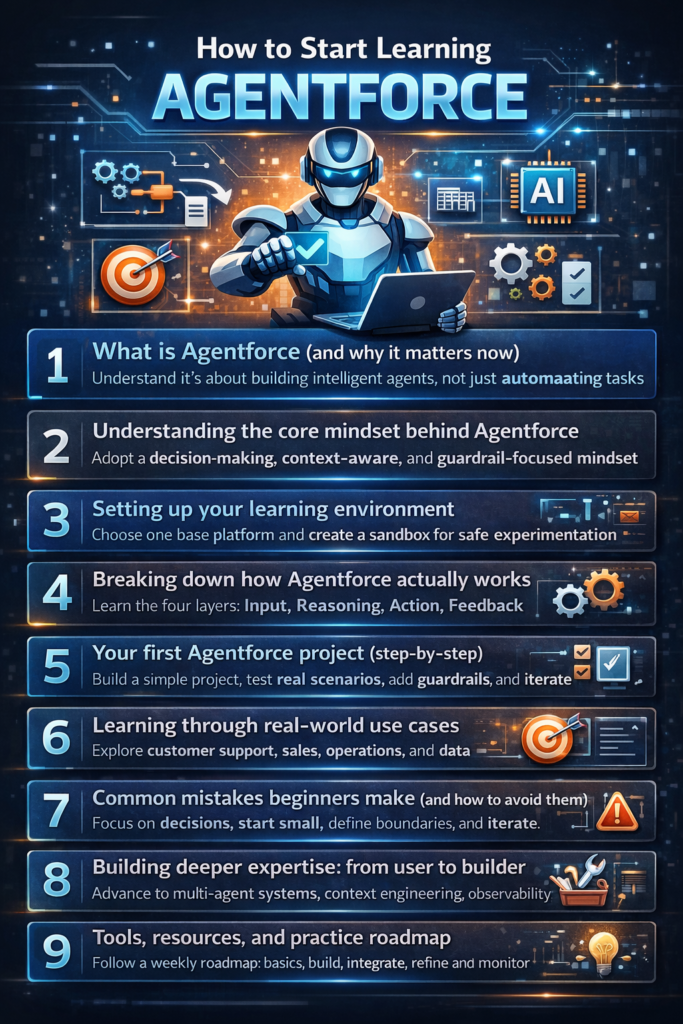
- What is Agentforce (and why it matters now)
- Understanding the core mindset behind Agentforce
- Setting up your learning environment
- Breaking down how Agentforce actually works
- Your first Agentforce project (step-by-step)
- Learning through real-world use cases
- Common mistakes beginners make (and how to avoid them)
- Building deeper expertise: from user to builder
- Tools, resources, and practice roadmap
- Final thoughts: how to stay ahead
1. What is Agentforce (and why it matters now)
Imagine you hire a new team member. You don’t just give them tasks—you give them context, tools, decision-making ability, and guardrails.
That’s exactly what Agentforce represents.
Agentforce is not just about automation. It’s about building intelligent agents that can:
- Understand context
- Take actions
- Learn from workflows
- Operate with minimal supervision
The shift here is important. We are moving from:
- Static automation → Dynamic decision-making systems
- Tools → Teammates
If you understand this early, your learning curve becomes much smoother.
2. Understanding the core mindset behind Agentforce
Before touching any tools, pause here.
Most beginners fail not because the system is complex, but because they approach it like traditional software.
Think like this instead:
Old way:
“How do I build this feature?”
Agentforce way:
“What should the agent decide and do on its own?”
Three mental models to adopt:
1. Agents = Decision Systems
Not scripts. Not workflows. They evaluate and act.
2. Context is everything
An agent without context is like an intern without instructions.
3. Guardrails > Instructions
You don’t control every step—you define boundaries.
3. Setting up your learning environment
Start simple. Avoid over-engineering.
Step 1: Choose your base platform
Agentforce typically integrates with:
- CRM systems
- Data platforms
- APIs
- AI/LLM layers
Pick one ecosystem to start. Don’t try everything at once.
Step 2: Create a sandbox mindset
You need a safe space to experiment:
- Dummy data
- Test workflows
- Isolated environments
Learning Agentforce without experimentation is like learning driving by reading a manual.
Step 3: Define a learning goal
Example goals:
- “Build a support automation agent”
- “Create a lead qualification agent”
- “Automate onboarding workflows”
Without a goal, you’ll just consume content without applying it.
4. Breaking down how Agentforce actually works
Let’s simplify the system into 4 core layers:
1. Input Layer
Where the agent gets data:
- User input
- CRM records
- Events
- APIs
2. Reasoning Layer
This is the brain:
- AI/LLM
- Rules
- Context evaluation
3. Action Layer
What the agent does:
- Send emails
- Update records
- Trigger workflows
- Call APIs
4. Feedback Layer
How it improves:
- Logs
- Outcomes
- Human corrections
A simple analogy:
Think of a restaurant manager:
- Input → Orders coming in
- Reasoning → Deciding priorities
- Action → Assigning staff
- Feedback → Customer satisfaction
That’s your Agentforce loop.
5. Your first Agentforce project (step-by-step)
Let’s build something simple.
Example: Lead Qualification Agent
Step 1: Define the goal
“Automatically qualify leads and assign priority.”
Step 2: Define inputs
- Lead name
- Company size
- Budget
- Industry
Step 3: Define logic (decision layer)
Example:
- If budget > $10k → High priority
- If industry = target segment → Boost score
- If missing data → Ask follow-up
Step 4: Define actions
- Update lead score
- Assign to sales rep
- Send follow-up email
Step 5: Add guardrails
- Never overwrite manual scores
- Flag uncertain cases
- Log all decisions
Step 6: Test with real scenarios
Run cases like:
- Incomplete lead
- High-value lead
- Irrelevant lead
Observe behavior.
Step 7: Iterate
Ask:
- Did the agent over-assume?
- Did it miss context?
- Were decisions explainable?
6. Learning through real-world use cases
The fastest way to learn Agentforce is through use cases.
Here are high-impact ones:
1. Customer Support Agent
Handles:
- FAQs
- Ticket classification
- Escalations
Learning focus: Context handling + fallback logic
2. Sales Assistant Agent
Handles:
- Lead scoring
- Follow-ups
- Meeting scheduling
Learning focus: Decision rules + prioritization
3. Operations Automation Agent
Handles:
- Internal workflows
- Approvals
- Task routing
Learning focus: Action orchestration
4. Data Enrichment Agent
Handles:
- Filling missing data
- External API calls
Learning focus: Integration + validation
7. Common mistakes beginners make (and how to avoid them)
Mistake 1: Treating agents like scripts
Fix: Focus on decisions, not steps
Mistake 2: Overloading with rules
Fix: Start minimal, iterate
Mistake 3: Ignoring edge cases
Fix: Always test “weird” scenarios
Mistake 4: No feedback loop
Fix: Track outcomes and refine
Mistake 5: No guardrails
Fix: Define boundaries early
8. Building deeper expertise: from user to builder
Once you’re comfortable:
Move into advanced areas:
1. Multi-agent systems
Agents collaborating with each other
2. Context engineering
Designing better inputs for smarter decisions
3. Prompt + rule hybrid systems
Combining deterministic and AI logic
4. Observability
Tracking agent decisions and outcomes
9. Tools, resources, and practice roadmap
Week 1–2:
- Understand basics
- Build 1 simple agent
Week 3–4:
- Build 2–3 use cases
- Add real data
Month 2:
- Introduce integrations
- Improve decision logic
Month 3:
- Build production-like system
- Add monitoring
Daily practice idea:
Instead of asking:
“What should I learn today?”
Ask:
“What can I automate or delegate to an agent today?”
10. Final thoughts: how to stay ahead
Agentforce is not a tool you “finish learning.”
It’s a capability you build over time.
The people who succeed here:
- Think in systems
- Experiment constantly
- Focus on outcomes, not features
One last perspective
If traditional software made humans faster,
Agentforce makes systems think.
And once you understand how to design thinking systems,
you’re no longer just building products,
you’re building decision-making engines.
Start small. Build one agent. Break it. Fix it. Repeat.


Responses