Am I Learning Agentforce the Right Way? A Journey Most People Don’t Talk About


If you’ve recently started exploring Salesforce’s Agentforce, there’s a question quietly sitting in the back of your mind:
“Am I actually learning this the right way… or just going through tutorials?”
You’re not alone.
The Moment of Doubt
A few months ago, I spoke with a product manager named Ravi. Smart, driven, already working in the Salesforce ecosystem. He had completed multiple modules, watched hours of demos, and even built a few basic flows.
But something felt off.
“I can follow tutorials,” he said,
“but if you ask me to solve a real business problem using Agentforce… I freeze.”
That’s the moment most learners hit. And that’s the moment that defines whether you’re learning… or just consuming content.
What Most People Get Wrong

Let’s be direct.
Learning Agentforce is not about:
- Completing Trailhead badges
- Memorizing features
- Rebuilding demo use cases
Those are starting points. Not the destination.
Agentforce is fundamentally about thinking like an AI-powered problem solver inside a business context.
If that mindset isn’t developing, something needs to change.
What “Learning the Right Way” Actually Looks Like


Let’s reframe this with real-world scenarios.
1. From Feature Learning → Problem Thinking
Wrong approach:
“I learned how to create an AI agent that responds to queries.”
Right approach:
“Where in a business does response time hurt revenue or experience?”
Scenario: Customer Support Automation
A retail company struggles with delayed responses during peak sales.
Instead of just building an agent, you think:
- What are the top 10 repetitive queries?
- Which ones need human escalation?
- How does response delay impact conversion?
Now your Agentforce solution becomes:
- AI agent handling 70% of repetitive queries
- Smart routing for high-value customers
- Context-aware responses using CRM data
That’s not learning a tool. That’s solving a business problem.
2. From Building Demos → Building Context

Ravi once built an agent that answered FAQs. It worked perfectly.
But when asked to apply it in his company, he struggled.
Why?
Because real-world environments are messy.
Scenario: Banking Industry
Imagine implementing Agentforce in a bank.
Customer asks:
“Why was my transaction declined?”
A demo agent gives a generic answer.
A real Agentforce solution:
- Pulls transaction data
- Checks fraud signals
- Identifies insufficient balance or rule triggers
- Responds with a personalized explanation
- Suggests next steps
Now you’re not building a chatbot. You’re designing decision intelligence.
3. From Isolated Learning → Ecosystem Thinking
Agentforce doesn’t exist alone.
It works with:
- CRM data
- APIs
- Workflows
- Security layers

Scenario: E-commerce Personalization
A customer visits an online store.
Agentforce can:
- Analyze past purchases
- Detect browsing behavior
- Trigger personalized recommendations
- Offer real-time discounts
But only if you understand:
- Data flows
- Integration points
- Customer lifecycle
This is where many learners plateau. They learn features but ignore the ecosystem.
The Shift That Changes Everything

The real transformation happens when you stop asking:
“How do I use Agentforce?”
And start asking:
“Where can intelligent agents create measurable impact?”
That shift moves you from:
- Learner → Practitioner
- Practitioner → Problem Solver
- Problem Solver → Leader
A Simple Self-Test

Ask yourself these 5 questions:
- Can I explain why I would use Agentforce in a business scenario?
- Can I identify processes that can be automated or augmented?
- Can I connect Agentforce with real data sources?
- Can I design outcomes, not just flows?
- Can I measure impact (time saved, revenue, experience)?
If you hesitated on more than two, your learning approach needs adjustment.
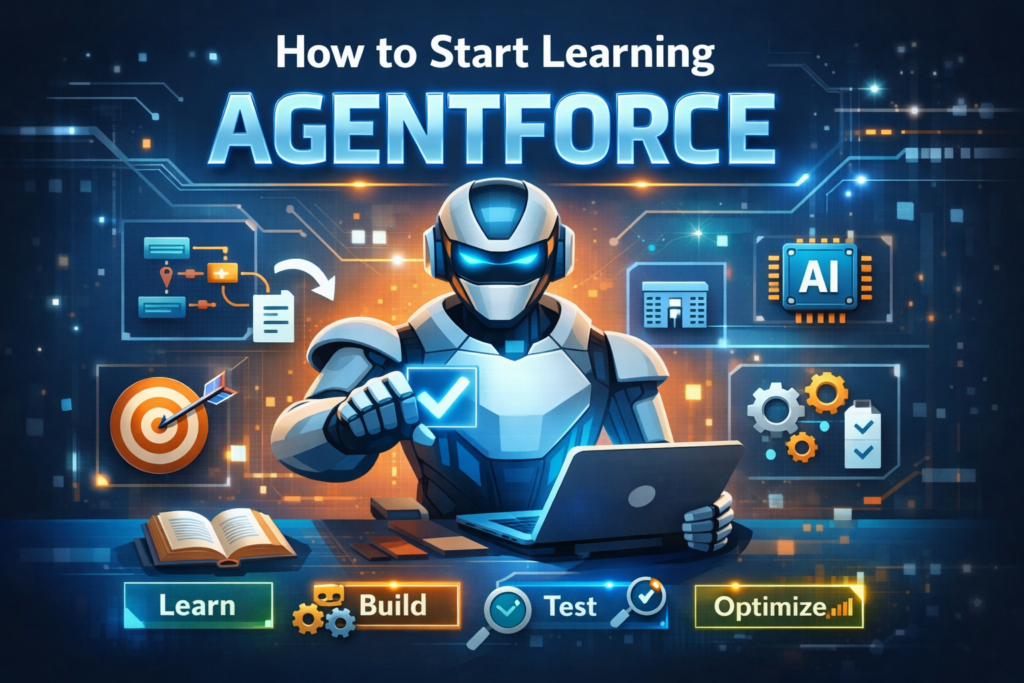
How to Start Learning the Right Way (Practical Path)

Instead of random learning, try this structure:
Step 1: Pick One Industry
Retail, Finance, Healthcare, Manufacturing
Step 2: Identify 3 Problems
Example:
- High support volume
- Low conversion rate
- Slow onboarding
Step 3: Design Agentforce Solutions
Not perfect. Just practical.
Step 4: Simulate Outcomes
- What improves?
- What gets faster?
- What gets cheaper?
This is how real expertise builds.
Ravi’s Turning Point

Ravi changed his approach.
Instead of learning features, he picked one problem:
Customer churn in a subscription product.
He built:
- A proactive Agentforce agent
- Triggered on low engagement signals
- Offering personalized retention actions
Three weeks later, he didn’t just “learn Agentforce.”
He understood its value.
And that changed everything.
Final Thought

If you’re asking “Am I learning Agentforce the right way?”
You’re already ahead of most people.
Because the real problem isn’t lack of resources.
It’s lack of direction and intent.
Learn less like a student.
Think more like a builder.
That’s where growth happens.

Responses