Salesforce Headless 360: The Future of Composable Customer Experiences
 By admin
Jul 4, 2026
6 min read
By admin
Jul 4, 2026
6 min read
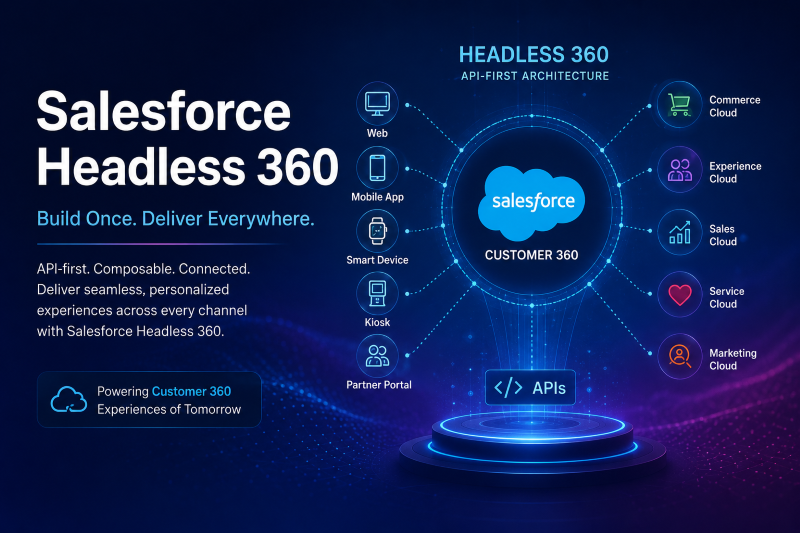
Build once. Deliver everywhere. Discover how Salesforce Headless 360 empowers organizations to create seamless, API-first digital experiences across every channel.
Salesforce Headless 360 Announcement
Salesforce Headless 360 is a new architecture that makes every major Salesforce capability available as an API, Model Context Protocol (MCP) tool, or CLI command, allowing developers and AI agents to interact with Salesforce without relying on the traditional web interface. Instead of performing tasks through the Salesforce UI, applications, coding agents, and AI assistants can directly access customer data, business logic, workflows, and automation from any platform or device.
The announcement introduces three major innovations:
- Developer-first access with more than 100 new tools and skills, including MCP tools, coding skills, and CLI commands that provide secure access to Salesforce data and metadata.
- Agentforce Experience Layer, a presentation layer that enables rich, interactive user experiences across channels such as Slack, ChatGPT, Claude, Microsoft Teams, WhatsApp, mobile apps, and custom web applications while keeping the backend logic centralized.
- Enterprise governance and testing tools that help organizations test, monitor, evaluate, and control AI agent behavior before and after deployment, ensuring reliable and secure operations at scale.
The core idea behind Headless 360 is that the user interface is no longer the center of Salesforce. Instead, Salesforce becomes a programmable enterprise platform where humans and AI agents can securely access the same data, workflows, permissions, and business logic from any application or channel. This enables organizations to build modern, omnichannel customer experiences while preserving the power of Customer 360, Data 360, Agentforce, and Slack.
In short, Salesforce Headless 360 transforms Salesforce from a browser-based CRM into an API-first, AI-ready enterprise platform, enabling developers to build faster, enterprises to deliver personalized experiences across every touchpoint, and AI agents to perform real business operations securely and intelligently.
Introduction
Modern customers interact with brands through websites, mobile applications, kiosks, IoT devices, smart TVs, and many other digital touchpoints. Traditional monolithic applications often struggle to deliver consistent experiences across these channels.
Salesforce Headless 360 introduces an API-first architecture that separates the frontend presentation layer from the backend business logic. This enables organizations to build engaging customer experiences while leveraging Salesforce’s powerful CRM, Commerce, and Customer 360 capabilities.
Whether you’re developing a React application, mobile app, or custom portal, Headless 360 allows developers to use modern frameworks while Salesforce securely manages customer data, commerce, and business processes.
Why Headless 360 Matters
The digital landscape demands flexibility, speed, and personalized customer experiences.
Headless 360 helps organizations by:
✔ Delivering omnichannel customer experiences
✔ Decoupling frontend and backend development
✔ Accelerating digital transformation
✔ Supporting modern JavaScript frameworks
✔ Enabling API-first integrations
✔ Reducing frontend deployment dependencies
“Build experiences without limitations while Salesforce powers the business logic.”
Approach of Headless 360
API-First Architecture
Frontend applications communicate with Salesforce through secure REST and GraphQL APIs.
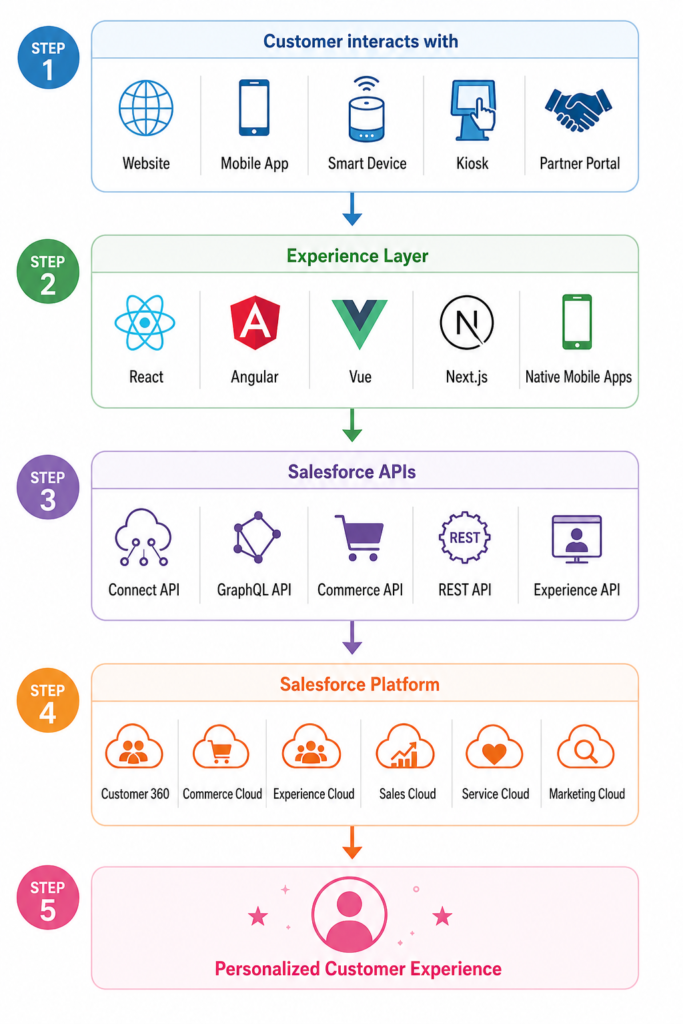
Imagine you’re shopping with a brand using a website, mobile app, smart device, kiosk, or even a partner portal. No matter which channel you choose, the experience should feel the same. In a Headless 360 architecture, the customer-facing interface (called the experience layer) is completely separate from the Salesforce backend. Developers can build modern, fast user interfaces using technologies like React, Angular, Vue, Next.js, or native mobile apps, while Salesforce securely provides all the customer, product, and business data through APIs. This separation gives organizations the freedom to innovate their digital experiences without changing the core business systems.
Behind the scenes, Salesforce APIs act as the bridge between the customer experience and the Salesforce Platform. These APIs retrieve and update information from Customer 360, Commerce Cloud, Experience Cloud, Sales Cloud, Service Cloud, and Marketing Cloud in real time. Because all customer data and business processes are connected in one platform, every interaction becomes personalized and consistent across every touchpoint. The result is a seamless customer journey where users receive relevant content, faster service, personalized recommendations, and a unified experience regardless of how or where they engage with the business.
Benefits of Headless 360
| Benefit | Description |
|---|---|
| 🚀 Faster Development | Frontend and backend teams work independently. |
| ⚡ Better Performance | Lightweight frontends improve page speed. |
| 📱 Omnichannel Support | Deliver experiences across web, mobile, IoT, and kiosks. |
| 🔄 API Reusability | Build once and consume APIs everywhere. |
| 🔒 Enterprise Security | Salesforce manages authentication and authorization. |
| 📈 Scalability | Easily support growing customer traffic. |
| 🎯 Personalization | Combine Customer 360 insights with custom experiences. |
| 💡 Future-Proof Architecture | Easily adopt new frontend technologies. |
How the Headless 360 Playground works?
The Headless 360 Playground makes it incredibly easy to interact with Salesforce using simple, natural language. Instead of writing SOQL queries or navigating multiple Salesforce screens, users can simply ask questions such as “Show me opportunities closing this month” or “Find accounts with no recent activity.” The playground automatically understands the request, retrieves the relevant Salesforce data through APIs, and presents it in a clear, easy-to-read format with summaries, tables, and actionable insights.

Beyond retrieving data, the playground can also perform Salesforce actions through conversational prompts. Users can create or update records, trigger business processes, summarize sales pipelines, identify at-risk opportunities, and execute workflows—all without writing code. This AI-powered interface enables administrators, developers, and business users to interact with Salesforce more efficiently, making data access and business operations faster, simpler, and more intuitive.
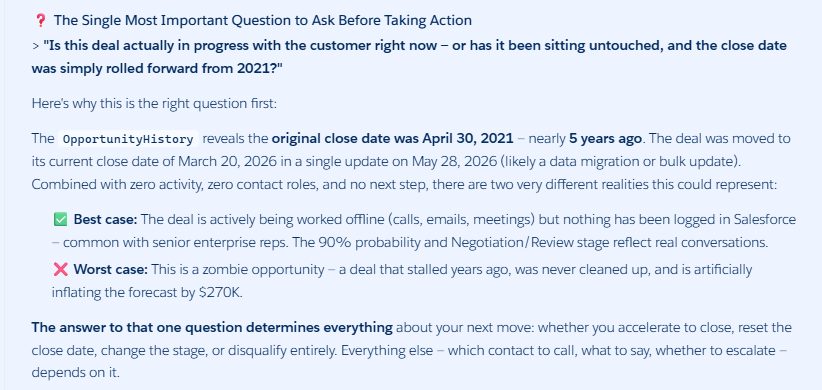
The Headless 360 Playground not only retrieves Salesforce data but also provides intelligent, context-aware recommendations in seconds. Instead of manually analyzing records, users can ask questions like “What should I do next with this opportunity?” or “Which deals are at risk?” The AI reviews customer data, history, activities, and business context to generate actionable recommendations, highlight potential risks, suggest the next best actions, and even explain the reasoning behind its suggestions. This enables sales teams to make faster, data-driven decisions without manually digging through multiple Salesforce records, significantly improving productivity and decision-making.
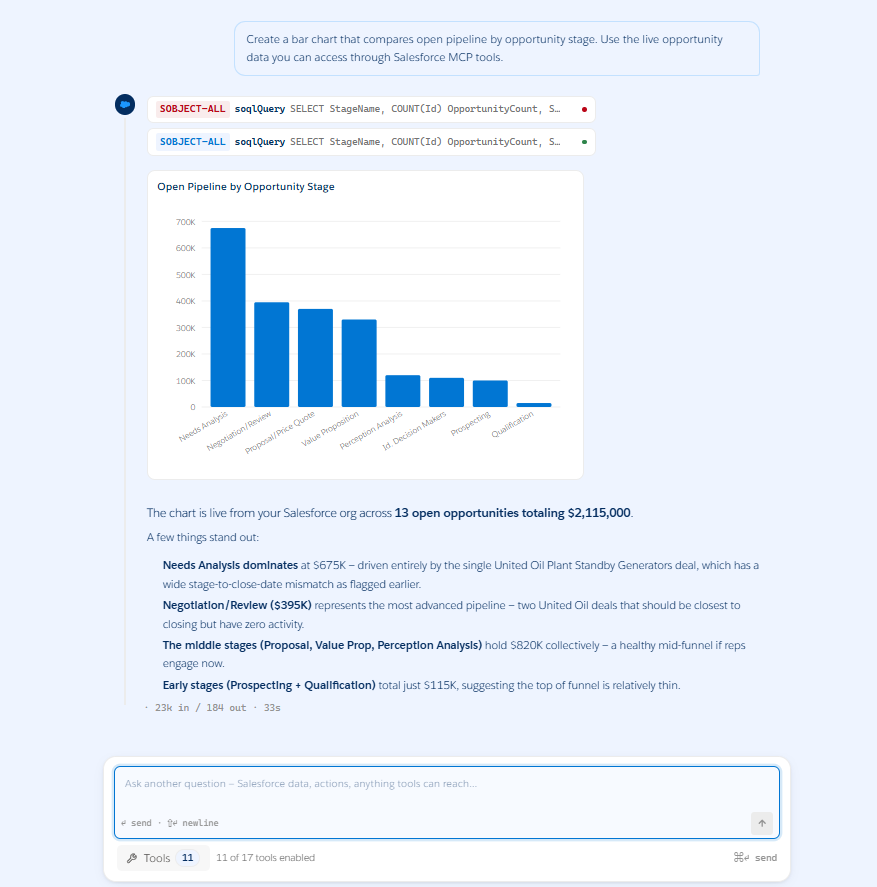
The Headless 360 Playground can generate charts and visual reports simply by understanding natural language prompts. Instead of manually creating reports or dashboards in Salesforce, users can ask questions like “Create a bar chart of open opportunities by stage,” and the AI automatically fetches live Salesforce data, builds the visualization, and provides meaningful insights. It not only displays the chart but also explains key trends, highlights important observations, and summarizes the data, making it easy for business users to understand their pipeline and make informed decisions without any technical expertise.
Learning Resources

Explore Salesforce Hosted MCPs, build with Agentforce Vibes, and ship Salesforce apps with React
Build with Headless 360
Official Documentation
Trailhead Modules
Recommended Skills
✔ REST APIs
✔ GraphQL
✔ OAuth 2.0
✔ JWT Authentication
✔ JavaScript
✔ React
✔ Node.js
✔ Experience Cloud
Real-World Use Cases
🛒 Headless Commerce
Create lightning-fast eCommerce storefronts powered by Commerce Cloud.
📱 Mobile Applications
Native Android and iOS apps accessing Salesforce through APIs.
🏦 Banking Portals
Customer onboarding, account management, and secure self-service portals.
🏥 Healthcare Experiences
Patient portals integrated with Salesforce Health Cloud.
🚗 Automotive
Connected vehicle apps with personalized customer experiences.
🛍 Retail Omnichannel
Web, mobile, kiosks, and in-store applications sharing the same Salesforce backend.
🤖 IoT Applications
Connected devices retrieving customer and product information using APIs.
🌍 Partner & Customer Portals
Custom-built portals with Salesforce Experience Cloud integration.
Conclusion
Salesforce Headless 360 represents the future of digital customer experiences.
By separating the frontend from the backend, organizations gain flexibility, scalability, and faster innovation while continuing to leverage Salesforce’s trusted CRM and Customer 360 platform.
Whether you’re modernizing legacy applications or building new digital products, Headless 360 provides the foundation for delivering seamless, personalized, and omnichannel experiences.
Build modern experiences. Connect every customer. Innovate without limits.
Frequently Asked Questions (FAQs)
Headless 360 is an API-first architecture that separates the frontend user interface from Salesforce backend services.
Commerce Cloud, Experience Cloud, Customer 360, Sales Cloud, Service Cloud, and other Salesforce APIs support Headless implementations.
No. You can build using React, Angular, Vue, Next.js, Flutter, native mobile apps, or any framework capable of consuming APIs.
Yes. Salesforce provides GraphQL APIs alongside REST APIs for efficient data retrieval.
Organizations building modern web applications, mobile apps, commerce experiences, customer portals, partner portals, or omnichannel digital platforms.
Start small, stay consistent, and watch your life change.